

How Long Does Local SEO Take? What the Ranking Data Actually Shows (2026)
Source: Ahrefs (2024)
KEY TAKEAWAYS
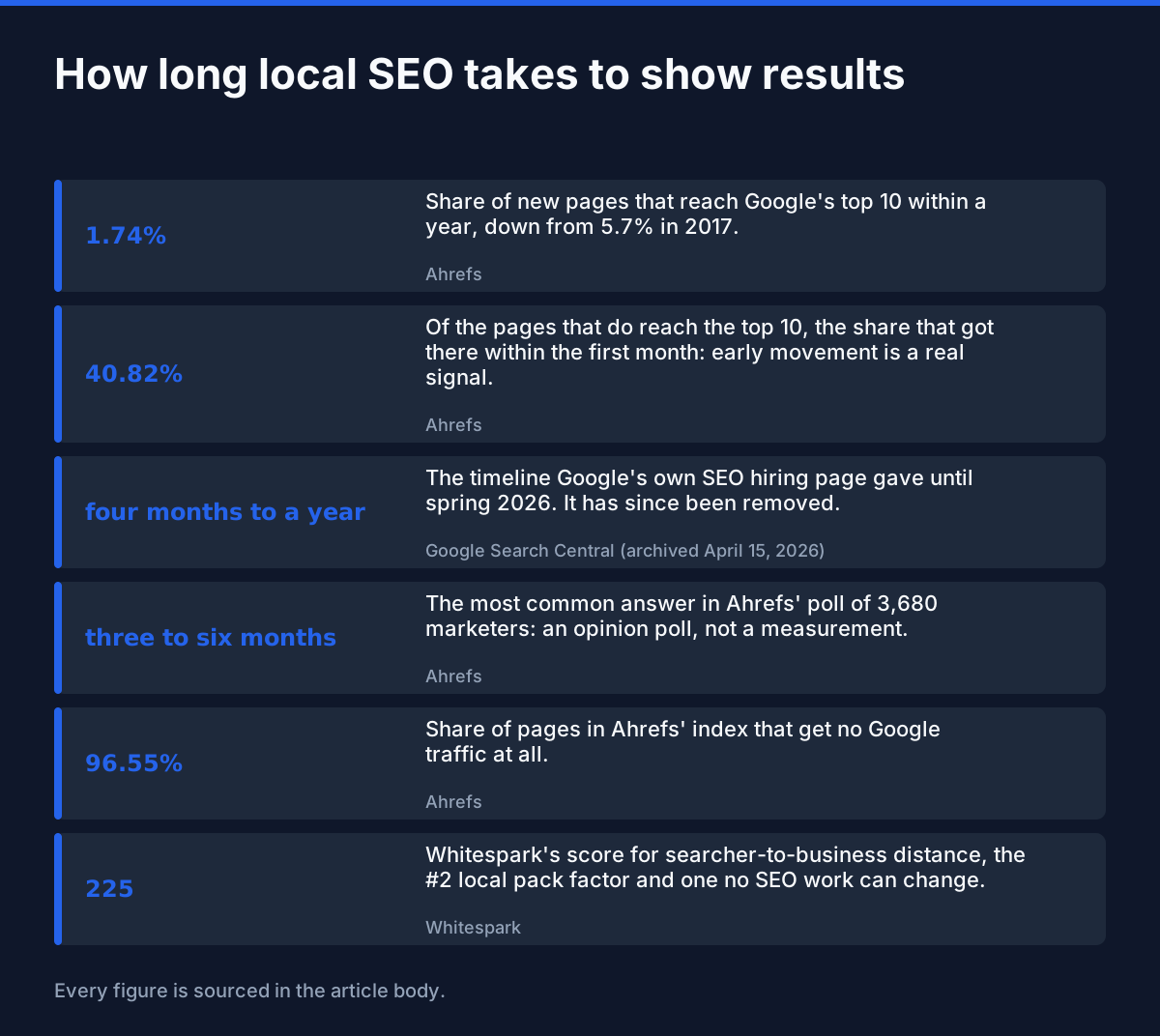
- → 1.74% Share of new pages that reach Google's top 10 within a year, down from 5.7% in 2017. (Ahrefs, 2024)
- → 40.82% Of the pages that do reach the top 10, the share that got there within the first month: early movement is a real signal. (Ahrefs, 2024)
- → four months to a year The timeline Google's own SEO hiring page gave until spring 2026. It has since been removed. (Google Search Central (archived April 15, 2026), 2026)
- → three to six months The most common answer in Ahrefs' poll of 3,680 marketers: an opinion poll, not a measurement. (Ahrefs, 2024)
- → 96.55% Share of pages in Ahrefs' index that get no Google traffic at all. (Ahrefs, 2023)
- → 225 Whitespark's score for searcher-to-business distance, the #2 local pack factor and one no SEO work can change. (Whitespark, 2025)
- → 41% Consumers who 'always' read reviews when choosing a local business in 2026, up from 29% a year earlier. (BrightLocal, 2026)
Ask any agency how long local SEO takes and you will hear the same answer: three to six months. That number traces back to a poll, not a study. When Ahrefs asked marketers, three to six months was the most common reply among 3,680 respondents (Ahrefs, 2024). The ranking data underneath it is much harsher. Only 1.74% of newly published pages reached Google’s top 10 within a year in Ahrefs’ tracking (Ahrefs, 2024).
This page lays out what is actually measured: what Google itself says about timing, including a timeline it removed from its own documentation this year, how often new pages break into the top 10, how many never get a single visit, and which local ranking signals can move in days versus the ones no amount of work will change. Every figure links to its source.
1 What Does Google Itself Say About How Long SEO Takes?
Less than it used to. Until spring 2026, Google’s page on hiring an SEO said results typically take four months to a year (Google Search Central (archived April 15, 2026), 2026). The current version drops the number and tells owners to ask the SEO what results to expect and in what timeframe (Google Search Central, 2026). Google’s other documentation gives only process timings: days for crawling and verification, months for site-wide changes.
| METRIC | VALUE | SOURCE |
|---|---|---|
| SEO timeline on Google’s hiring page until spring 2026 | four months to a year | Google Search Central (archived April 15, 2026) |
| What the page now tells owners to ask | in what timeframe | Google Search Central |
| Time to recrawl a changed page | a few days to a few weeks | Google Search Central |
| Time for site-wide improvements to register | several months | Google Search Central |
| Google Business Profile verification review | up to 5 business days | Google Business Profile Help |
| Google’s main local ranking factors | relevance, distance, and popularity | Google Business Profile Help |
Google’s “Do you need an SEO?” page carried the four-months-to-a-year line in an archived snapshot from April 15, 2026; by June the page had been retitled and the sentence was gone. The replacement advice is arguably better for business owners: instead of a promised window, Google tells you to ask any prospective SEO what results they expect and when, and to hold them to it. That is the same standard we suggest for evaluating any search engine optimization proposal.
What Google still documents are the mechanical delays. Recrawling a changed page can take a few days to a few weeks (Google Search Central, 2026), a new Business Profile’s verification review can take up to 5 business days (Google Business Profile Help, 2026), and after broad site improvements it could take several months for Google’s systems to confirm the change, sometimes waiting for the next core update (Google Search Central, 2026). Local results rest on relevance, distance, and popularity (Google Business Profile Help, 2026); the middle one is fixed by your address. If you are new to these terms, our digital marketing glossary defines them in plain English.
For an owner weighing an agency proposal, the practical reading is simple. Anything Google documents in days, such as verification and recrawling, should show up in the first weeks of a campaign as a verified profile, indexed pages and early impressions in Search Console. Anything that depends on Google re-evaluating a whole site can lag by months. A good report separates the two so you can see which clock each change is on, instead of judging everything by the one ranking you check on your phone.
2 Where Does the “Three to Six Months” Answer Come From?
A poll. Ahrefs asked its audience on LinkedIn and X how long SEO takes, and three to six months was the most common answer from 3,680 respondents (Ahrefs, 2024). It reflects what practitioners believe, which is useful, but it is not a measurement of how long rankings or leads actually took for real businesses.
| METRIC | VALUE | SOURCE |
|---|---|---|
| Most common answer in the Ahrefs poll | three to six months | Ahrefs |
| Poll respondents | 3,680 | Ahrefs |
| Former Google hiring-page timeline | four months to a year | Google Search Central (archived April 15, 2026) |
The poll and Google’s old wording overlap, which is why the range feels settled: three to six months is roughly where the bottom of Google’s former window and the practitioner consensus meet. A wave of agency articles published in the last month repeat the same range almost word for word, and almost none link to anything measured. That does not make the range wrong for a typical local campaign, but it means you should treat it as an expectation to discuss, not a guarantee to sign.
A better question for any agency is what will move first and how you will see it. Our page on what SEO is and how it works covers the basics; the sections below show what the measured data says to watch for.
Practitioner consensus also hides how much the starting point matters. A business with an established domain, a verified profile and a few dozen reviews is starting a different race from a brand-new company with a fresh website and no links. The same poll answer gets applied to both, which is how owners of new businesses end up disappointed at month three and owners of established ones end up overpaying for results that were already on the way.
3 How Many New Pages Actually Reach Google’s Top 10?
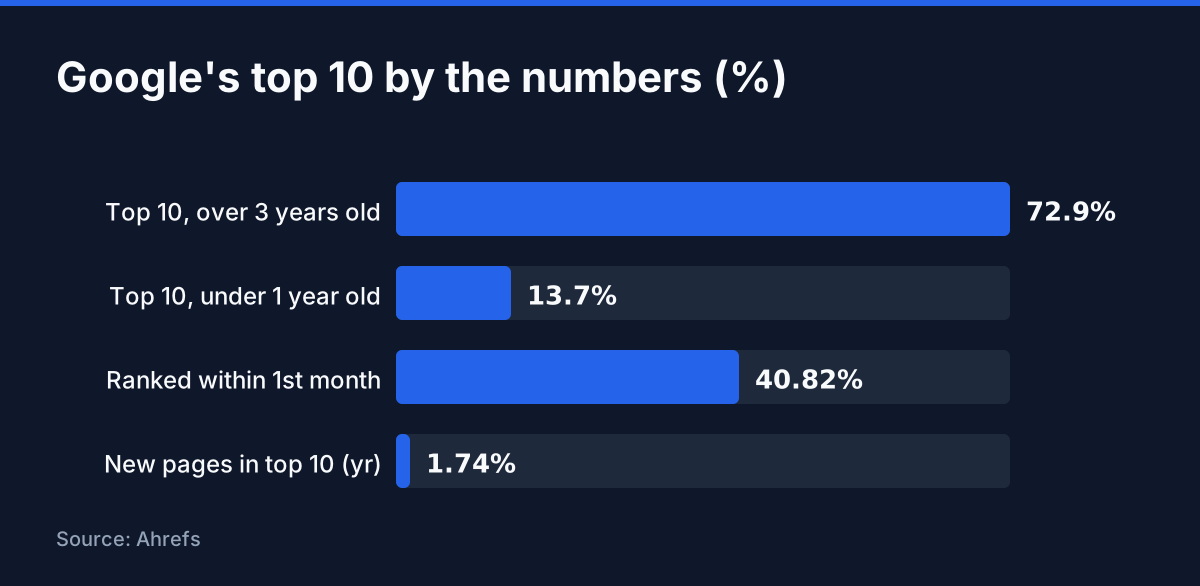
Very few, and the bar has risen. Ahrefs tracked one million newly seen URLs for a year and only 1.74% reached the top 10, down from 5.7% in its 2017 study (Ahrefs, 2024). Filtering to non-empty English pages lifted the figure to 6.11%. But of the pages that did rank, 40.82% got there within their first month.
| METRIC | VALUE | SOURCE |
|---|---|---|
| New pages reaching the top 10 within a year | 1.74% | Ahrefs |
| Same measure, 2017 study | 5.7% | Ahrefs |
| New non-empty English pages reaching the top 10 | 6.11% | Ahrefs |
| Top-10 pages that got there in their first month | 40.82% | Ahrefs |
| Top-10 pages more than three years old | 72.9% | Ahrefs |
| Top-10 pages under one year old | 13.7% | Ahrefs |
| Average age of a #1 page (years) | 5 | Ahrefs |
| Average age of a #1 page in 2017 (years) | 2 | Ahrefs |
Two findings pull in opposite directions, and both matter to a business owner. Most new pages never make it, and older pages dominate: 72.9% of top-10 results are more than three years old, only 13.7% are under a year old, and the average #1 page is 5 years old, up from 2 in 2017 (Ahrefs, 2024). At the same time, the pages that do succeed often show it quickly. That is the strongest argument against waiting a full year in silence: early impressions and ranking movement are a real signal, and a page showing nothing after a few months probably needs to change, not just age.
Local businesses have an advantage the averages hide. Ahrefs’ sample covers every kind of site and keyword, while a service business competing for “near me” searches in one metro is fighting a much smaller field. The age data still applies, which is why consistent, long-lived service pages, like our Twin Falls SEO page, tend to outperform pages that are rewritten or replaced every few months.
The practical test that follows from this data is to look for early movement on the specific searches you care about, not overall traffic. If a new service page is collecting impressions and creeping up from page five to page two within its first couple of months, it is behaving like the pages that eventually win. If it has not been indexed or shows no impressions at all after that long, the problem is usually the target, the content or the links, and waiting longer rarely fixes it.
4 Why Do Most Pages Never Get Any Search Traffic?
Because they target nothing people search for, or nothing they can win. Ahrefs found 96.55% of the pages in its index get zero traffic from Google, and another 1.94% get only one to ten visits a month (Ahrefs, 2023). Its analysis points to two main causes: no real search demand for the topic and no backlinks.
| METRIC | VALUE | SOURCE |
|---|---|---|
| Pages getting zero Google traffic | 96.55% | Ahrefs |
| Pages getting one to ten visits a month | 1.94% | Ahrefs |
| New pages reaching the top 10 within a year | 1.74% | Ahrefs |
This is the part of the timeline question that gets skipped. A page that targets a phrase nobody searches, or a phrase dominated by national sites, will not rank in six months or six years. So before asking how long SEO takes, it is worth asking whether each page is aimed at a search a local customer actually makes. That is the core of our local SEO services: pick winnable, high-intent searches first so early movement is possible at all.
Links are the other half. Ahrefs found a clear correlation between referring domains and traffic, and its own analysis notes that pages ranking without links are almost always on low-competition topics. For a small business that usually means local links: chambers, sponsors, suppliers and local press. Our article on why SEO matters for small businesses explains why those slow-building signals compound over time.
5 What Moves First in Local Search, and What Never Moves?
Profile settings move first; distance never moves. In Whitespark’s 2026 survey of local SEO experts, the top local pack factor is primary Business Profile category, scored 227, followed by searcher-to-business distance at 225 (Whitespark, 2025). Category and business-title keywords are settings you can change in a day; distance is fixed by where the customer is standing.
| METRIC | VALUE | SOURCE |
|---|---|---|
| Primary GBP category (#1 factor score) | 227 | Whitespark |
| Distance to the searcher (#2 factor score) | 225 | Whitespark |
| Keywords in GBP business title (#3 factor score) | 223 | Whitespark |
| Physical address in city of search (#4 factor score) | 213 | Whitespark |
| High Google star ratings (#6 factor score) | 181 | Whitespark |
| Quantity of Google reviews (#9 factor score) | 170 | Whitespark |
| Recency of reviews (#11 factor score) | 164 | Whitespark |
| Steady influx of reviews (#14 factor score) | 154 | Whitespark |
| Consumers who read reviews for local businesses | 97% | BrightLocal |
| Consumers who always read reviews, 2026 | 41% | BrightLocal |
| Consumers who always read reviews, prior year | 29% | BrightLocal |
This is where the timeline question gets a practical answer. The fastest movers are Business Profile fixes: the right primary category, accurate hours, services and a clean business name. Several of the top-scored factors are settings an owner controls directly, so a neglected profile can often improve within weeks of verification. Distance and a physical address in the searched city cannot be changed by SEO at all, which is why a business can rank first in its own neighborhood and nowhere across town. For multi-location markets like our Chandler, Arizona and San Diego clients, that geography sets the ceiling for the whole campaign.
Reviews sit in the middle: they build steadily rather than all at once. Whitespark’s experts score star ratings at 181, review count at 170, recency at 164 and a sustained influx at 154, and customers are reading them more. BrightLocal’s 2026 survey found 97% of consumers read reviews for local businesses and 41% always do, up from 29% a year earlier (BrightLocal, 2026). A business that asks every customer for a review is building a signal that keeps paying after the campaign’s first months. If paid visibility is needed while that builds, Google Ads can cover the gap.
Put together, a realistic local timeline has three speeds. Profile and technical fixes can register within days or weeks of Google processing them. Reviews, content and local links build over months, and their effect compounds as competitors stand still. Distance and physical location never change, so the honest goal is to win the area around your address first and expand outward, rather than promising citywide rankings from a single location. Ask any agency, including us, to show you which of those three speeds each line of a proposal belongs to.
Explore every figure in this article
Methodology
We gathered measured data on search timelines from Ahrefs’ ranking and traffic studies, Google’s own Search Central and Business Profile documentation, Whitespark’s 2026 Local Search Ranking Factors survey and BrightLocal’s 2026 Local Consumer Review Survey. Every source URL was fetched and each figure matched against the page. The removal of Google’s ‘four months to a year’ sentence was confirmed by comparing Wayback Machine snapshots of the same page: present on April 15, 2026, absent by June 9, 2026 and from the live page. BrightLocal’s page could not be fetched by our automated verifier because of a TLS incompatibility, so its figures were confirmed by opening the page directly. Ahrefs’ ranking data covers all websites, not only local businesses, and Whitespark’s scores are expert ratings rather than measured ranking weights. Research stages that ran in reduced form: the competitor backlink format filter found only a business directory with an editorial link profile, so it did not inform the format choice, and one of fifteen search-results checks failed after retries.
- Sources consulted: 34
- Sources cited: 11
- Data freshness: current year: 6, last year: 1, older: 4
- Data range: 2017-01-01 to 2026-09-29
- Research date: 2026-09-29
- Update schedule: Annually, after Whitespark's ranking factors and BrightLocal's consumer survey
- Limitations: No public study measures local SEO timelines for small businesses directly; page-level ranking data from Ahrefs covers all sites, not only local ones. Whitespark scores are expert-survey ratings, not measured ranking weights. The 'three to six months' figure is a poll of marketers.
Frequently Asked Questions
How long does local SEO take to show results?
There is no measured standard. The figure most agencies quote, three to six months, is the most common answer in an Ahrefs poll of 3,680 marketers, not a study of outcomes. Ranking data shows most new pages never reach the top 10, while about 40% of those that do get there within a month, so early movement matters. (Ahrefs, 2024)
Does Google say how long SEO takes?
Not anymore. Until spring 2026, Google's page on hiring an SEO said results typically take four months to a year. That sentence was on the page in an April 15, 2026 archive snapshot and is gone from the current version, which now tells owners to ask the SEO what results to expect and in what timeframe. (Google Search Central (archived April 15, 2026), 2026)
What percentage of new pages reach Google's top 10?
Very few. Ahrefs tracked one million newly seen URLs for a year and found only 1.74% reached the top 10, down from 5.7% in its 2017 study. Filtering to non-empty English pages raised the figure to 6.11%. The average #1-ranking page is five years old. (Ahrefs, 2024)
How fast can Google Business Profile changes help?
Some of the fastest local wins are profile fixes. Google says verification reviews take up to 5 business days, and the top-rated local pack factors in Whitespark's 2026 survey, primary category and keywords in the business title, are profile settings. Distance from the searcher, the #2 factor, cannot be changed by any SEO work. (Google Business Profile Help, 2026)
Why can SEO results take months after changes are made?
Google says recrawling a changed page can take a few days to a few weeks, and that after site-wide improvements it could take several months for its systems to confirm the change, sometimes waiting for the next core update. That lag is why month-one rankings are a poor verdict on a campaign. (Google Search Central, 2026)
Do reviews affect how fast local SEO works?
Reviews are both a ranking signal and a conversion signal. BrightLocal's 2026 survey found 97% of consumers read reviews for local businesses and 41% always read them, up from 29%. Whitespark's experts rate review quantity, recency and a steady influx of reviews among the top local pack factors. (BrightLocal, 2026)
Sources & References
- Ahrefs. “How Long Does It Take to Rank in Google?.” ahrefs.com/blog/how-long-does-it-take-to-rank/. Accessed 2026-09-29.
- Ahrefs. “96.55% of Content Gets No Traffic From Google.” ahrefs.com/blog/search-traffic-study/. Accessed 2026-09-29.
- Ahrefs. “How Long Does SEO Take? (poll of 3,680 marketers).” ahrefs.com/blog/how-long-does-seo-take/. Accessed 2026-09-29.
- Google Search Central (archived April 15, 2026). “What is an SEO expert? (Wayback Machine snapshot, April 15, 2026).” web.archive.org/web/20260415051330/https://developers.google.com/search/docs/fun. Accessed 2026-09-29.
- Google Search Central. “Do You Need an SEO? Tips for Hiring an SEO.” developers.google.com/search/docs/fundamentals/do-i-need-seo. Accessed 2026-09-29.
- Google Search Central. “Google Search's core updates.” developers.google.com/search/docs/appearance/core-updates. Accessed 2026-09-29.
- Google Search Central. “Ask Google to recrawl your URLs.” developers.google.com/search/docs/crawling-indexing/ask-google-to-recrawl. Accessed 2026-09-29.
- Google Business Profile Help. “Verify your business on Google.” support.google.com/business/answer/7107242?hl=en. Accessed 2026-09-29.
- Google Business Profile Help. “Tips to improve your local ranking on Google.” support.google.com/business/answer/7091?hl=en. Accessed 2026-09-29.
- Whitespark. “2026 Local Search Ranking Factors.” whitespark.ca/local-search-ranking-factors/. Accessed 2026-09-29.
- BrightLocal. “Local Consumer Review Survey 2026.” brightlocal.com/research/local-consumer-review-survey/. Accessed 2026-09-29.
Last updated:


